Leaders are being asked to make faster decisions, keep teams aligned and engaged, and lead change in an increasingly AI-enabled workplace.
And they’re doing so amid workload and productivity pressure, budget constraints, changing workforce needs, and limited time for development – all while being expected to sustain performance.
Organisations need more than a strong strategy to drive performance; they need leaders who can translate that strategy into action.
At Alchemist, we call it the Leadership Execution Gap: the distance between what organisations expect of their leaders and what those leaders consistently do in the flow of work.
L&D leaders can help close the Leadership Execution Gap by developing the right skills and behaviours, but only if that development is designed as a system for sustained behaviour change, not one-off interventions.
Key takeaways from the research:
- Manager performance is increasing for some, but not broadly enough. Nearly half of respondents reported that the percentage of people managers meeting expectations stayed the same or declined, reinforcing the need to assess whether development is changing how managers lead.
- Consistent use of a leadership framework is linked to stronger manager performance, improved change effectiveness, and more extensive use of AI in leadership or management work or development.
- AI is already part of leadership and management work, but most organisations report limited use or pilots, suggesting room for more extensive use.
The 2026 Leadership Execution Gap Report
As urgent priorities arise, leaders need to sustain manager development. Get insights into the link between performance and management.
Leadership Development Must Change How Leaders Operate
The challenges and priorities L&D teams have faced this year paint a stark picture of today’s learning landscape, but also show a clear path for where L&D teams should focus going forward.
Alchemist’s 2026 Leadership Execution Gap research points to a clear requirement: leadership development must be designed as a system for changing how leaders operate.
But how do you do this?
Many organisations are already building leadership capability; however, our research reveals that more needs to be done to ensure new behaviours show up in the work itself.
Here are six areas learning leaders need to focus on to close the Leadership Execution Gap in 2027:
- Leadership Development Has to Work Under Pressure
- L&D Leaders Face the Urgent and Foundational Agenda
- Connect Development to Performance and Change
- Leadership Expectations Must Reach Daily Work
- Sustaining Behaviour Change Requires Reinforcement
- AI Capability Requires More Than Tool Access
1. Leadership Development Has to Work Under Pressure
Leadership development is taking place under significant operating pressure. In the research, the most common factors affecting organisations’ ability to develop their leaders and managers were:
- Workload and productivity pressure (90.2%)
- Budget pressure and cost-cutting (88.7%)
- Talent-market instability (88.0%)
- AI and technology disruption (81.6%)
- Remote and hybrid complexity (81.6%)
These pressures reveal a two-fold challenge: the lack of time and resources available for development, and the need for support with immediate challenges. The latter includes making decisions with incomplete information, focusing teams when priorities compete, addressing resistance, leading difficult conversations, and maintaining performance through change.
Learning also needs to link directly to leaders’ work. Models and principles offer useful guidance, but the examples, decisions, and trade-offs should come from your organisation’s current operating environment. When the context is recognisable, leaders can connect learning directly to the work in front of them.
2. L&D Leaders Face an Urgent and Foundational Agenda
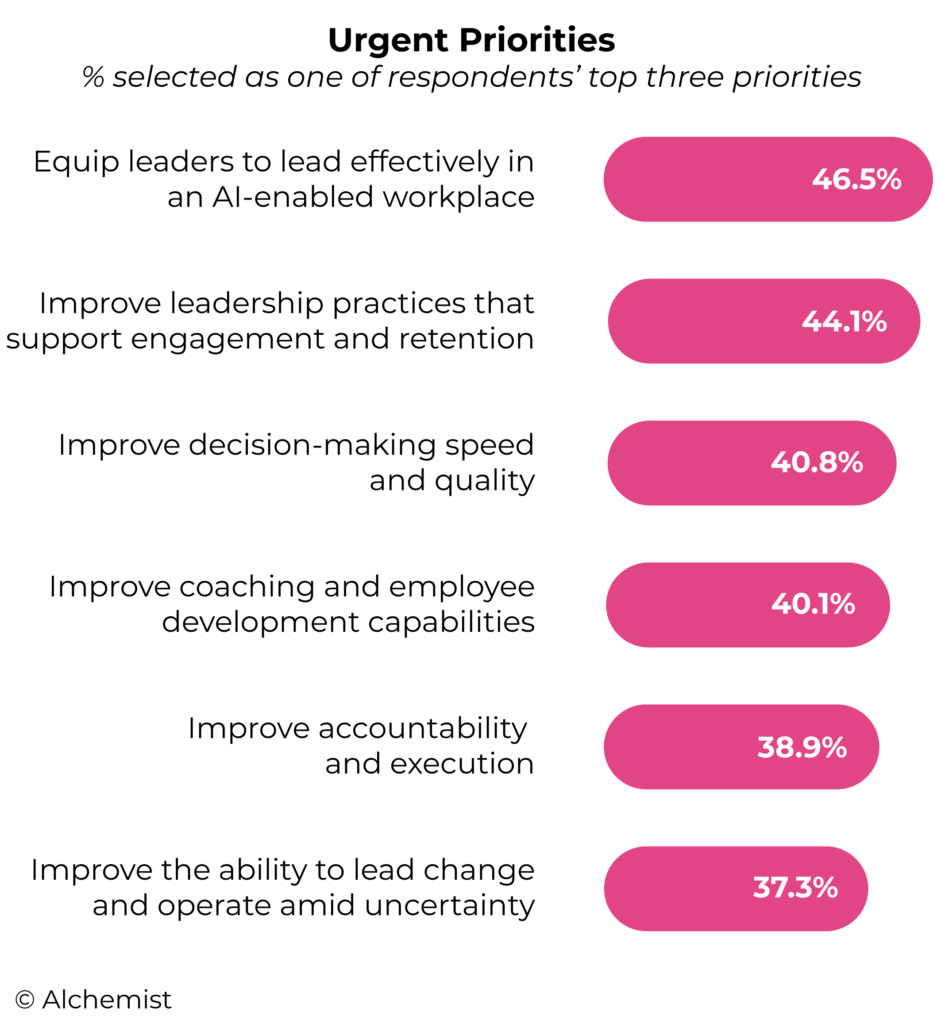
When research respondents were asked to select their top three priorities, six areas rose to the top:
- Equip leaders to lead effectively in an AI-enabled workplace (46.5%)
- Improve leadership practices that support engagement and retention (44.1%)
- Improve decision-making speed and quality (40.8%)
- Improve coaching and employee-development capabilities (40.1%)
- Improve accountability and execution (38.9%)
- Improve the ability to lead change and operate amid uncertainty (37.3%)
But these urgent priorities are only part of the agenda.
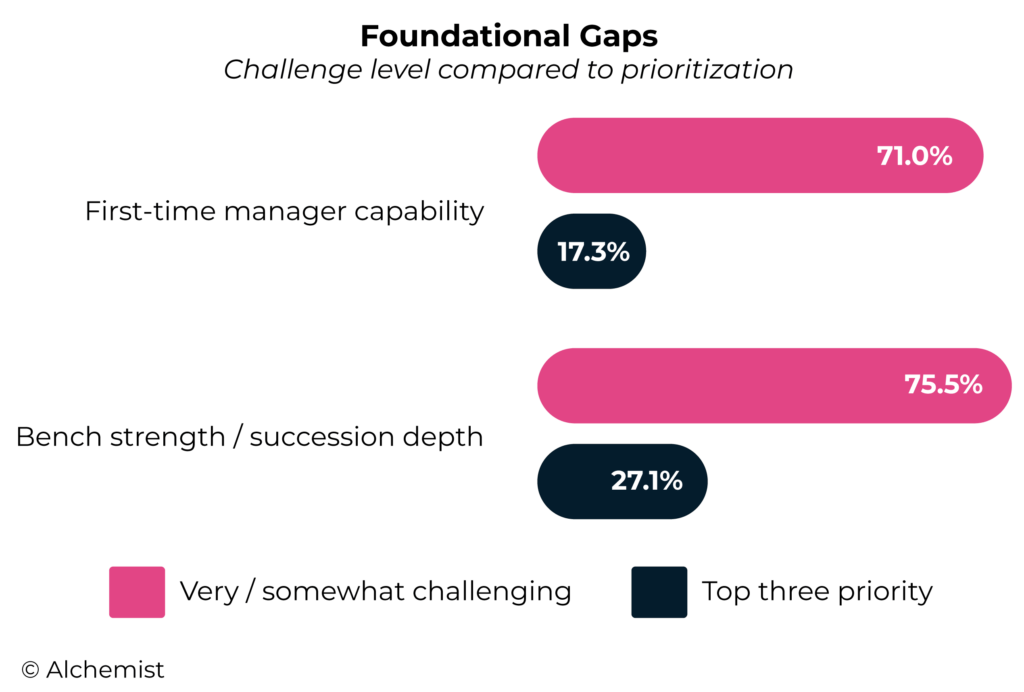
First-time manager capability is challenging for 71.0% of organisations, yet only 17.3% select it as one of their top-three priorities. Bench strength shows a similar gap: 75.5% rate it challenging, while 27.1% select it as a top-three priority.
L&D leaders face a dual task: addressing immediate execution needs while continuing to build the manager capability and bench strength on which future performance depends.
Addressing this dual agenda requires focus:
- L&D leaders need to clarify the business or talent outcome at stake
- Identify the leadership behaviours required to reach that outcome
- Determine whether it’s leadership capability or behaviour that’s hindering progress
- Development can then target the relevant gap while continuing to build the foundational capabilities the organisation needs
Without understanding what the business needs, a broad curriculum may cover worthwhile topics yet leave the behaviours limiting performance unchanged.
3. Connect Development to Performance and Change
Just over half of organisations (51.4%) report an increase in the percentage of people managers meeting performance expectations, leaving 48.5% to report that the percentage stayed the same or declined.
Connecting development to performance is essential to demonstrating wider impact. This requires more than tracking programme completion and favourable participant ratings.
Managers must:
- Set clear expectations
- Coach early enough to affect performance
- Address difficult issues before they grow
- Reinforce priorities when attention drifts
- Keep people focused during uncertainty
These observable behaviours can be practised, coached, and measured, giving the organisation a stronger basis for assessing whether managers are leading differently.
Managers’ roles are especially visible during change. Among organisations reporting improved effectiveness in leading change or transformation, 66.5% also report an increase in the percentage of managers meeting performance expectations. This finding doesn’t establish causation, but it’s consistent with the role managers play in turning change into daily work.
An organisation-wide announcement can explain the direction, but managers still have to clarify what it means for people’s roles, which priorities have changed, and what happens next. They’re responsible for holding their teams accountable for applying the new behaviours. They hear concerns that may not reach the change team, see where old habits return, and reinforce new expectations over time.
Leadership development should prepare managers for that work: responding to resistance, coaching through uncertainty, and sustaining momentum beyond the initial launch. Treating change solely as a communication exercise leaves these responsibilities unaddressed.
4. Leadership Expectations Must Reach Daily Work
It sounds simple, yet one of the strongest patterns in the research is the difference seen by organisations that consistently use a defined leadership model or competency framework.
Organisations using a framework consistently are significantly more likely than those reporting anything less than consistent use to report:
- An increase in the percentage of managers meeting performance expectations (66.9% compared with 31.9%)
- Improved effectiveness in leading change (75.2% compared with 46.8%)
- Extensive AI use in leadership or management work or development (51.9% compared with 12.6%)
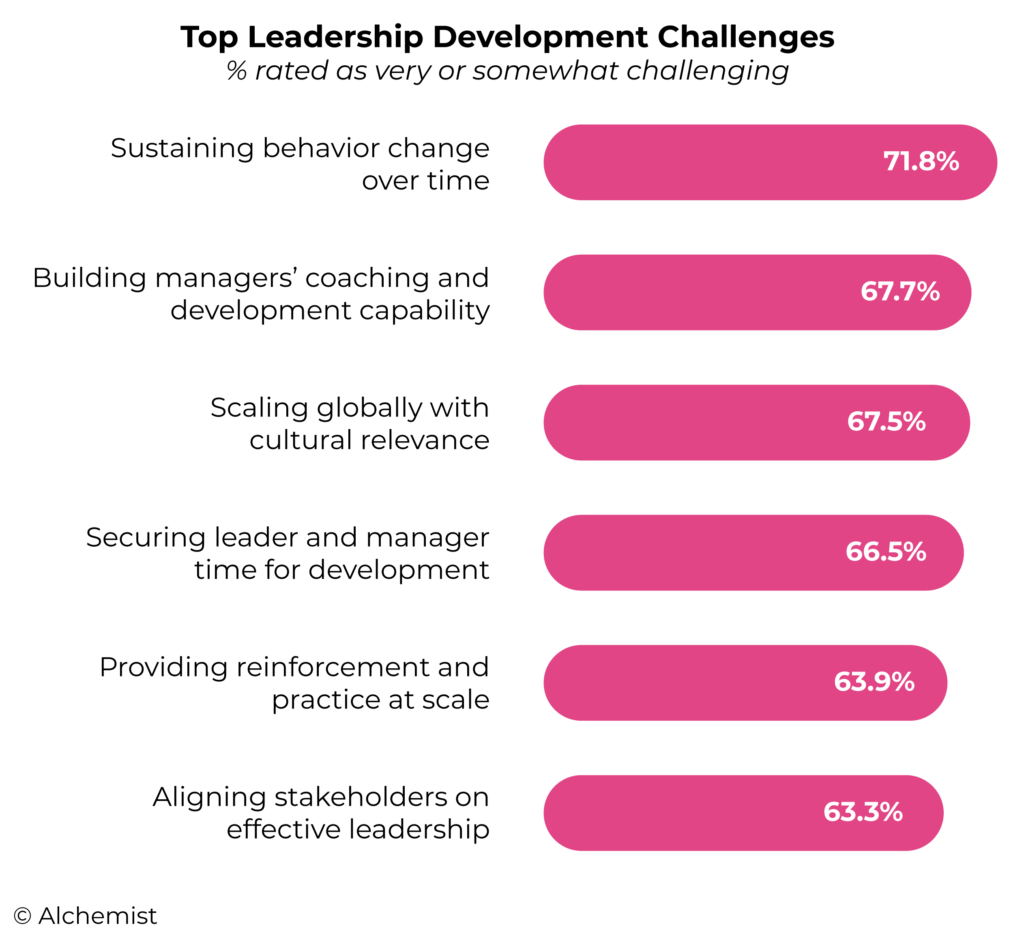
This doesn’t mean that framework use produced these differences, and extensive AI use measures adoption rather than performance. Still, consistent framework use may be a marker of a more mature leadership-development system – one that defines effective leadership, focuses development, and reinforces expected behaviours.
For L&D leaders looking to create impact, the takeaway isn’t to simply create a model or framework, but to make it operational. Its expectations should shape development objectives, realistic practice, coaching, performance feedback, and measurement. It should also guide how leaders make decisions, manage people, and handle difficult conversations.
5. Sustaining Behaviour Change Requires Reinforcement
While many organisations are developing capabilities, it’s often what comes next that matters most.
The most widely reported leadership development challenge is:
- Sustaining behaviour change over time (rated very or somewhat challenging by 71.8% of respondents)
- Building managers’ capability to coach and develop their people (67.7%)
- Designing development for global and cultural relevance (67.5%)
- Securing time from leaders and managers for development (66.5%)
- Providing reinforcement and practice at scale (63.9%)
- Aligning stakeholders on effective leadership (63.3%)
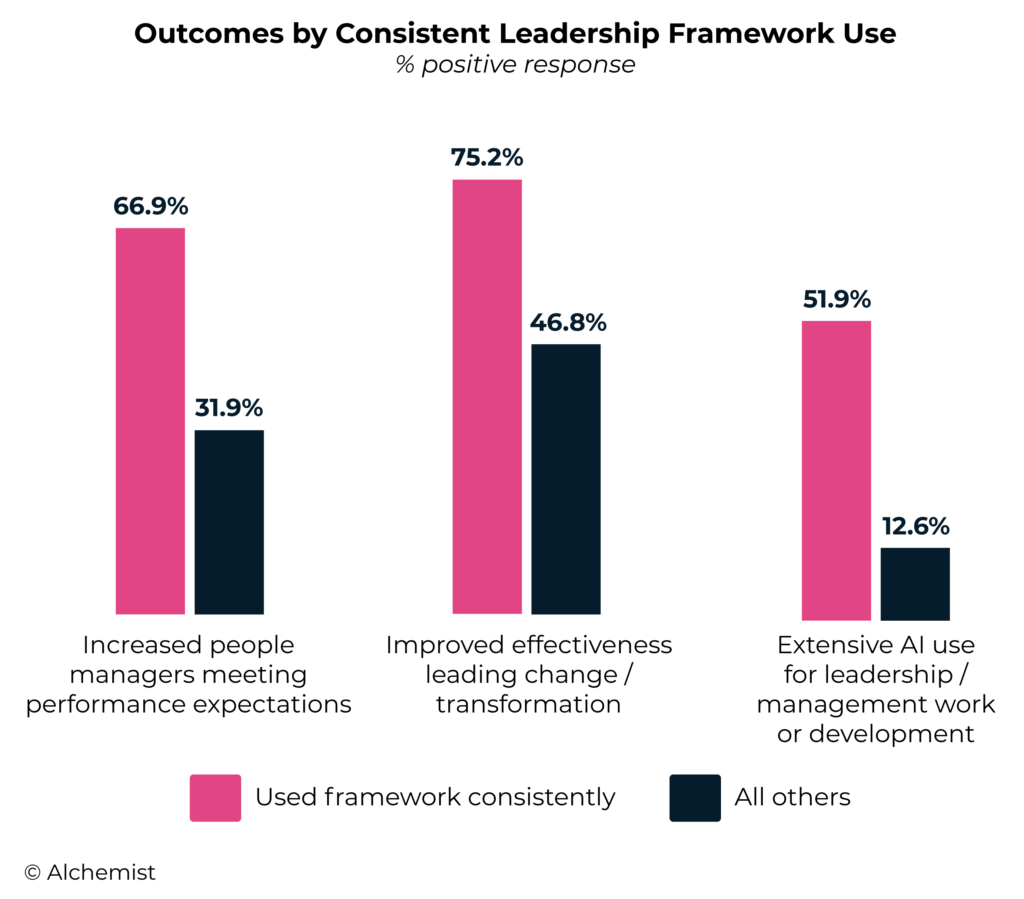
Many of these challenges show up when leaders try to apply what they’ve learned. A concept may make sense during a session yet prove difficult to use when daily pressures return, the working environment rewards old behaviours, or a manager doesn’t know what to observe and coach. Development that works in one region may also lose relevance elsewhere without local adaptation.
For L&D leaders, sustaining behaviour change requires continued support in day-to-day work:
- Time for leaders to practise and receive feedback
- Clear coaching and reinforcement roles for managers
- Organisational routines, measures, and senior-leader expectations aligned with the same behaviours
In global programmes, that support should be adapted to local contexts without losing the common leadership standard.
Structured programmes can introduce new behaviours, but sustaining their use requires practice, coaching, and reinforcement beyond the learning experience.
6. AI Capability Requires More Than Tool Access
In our study, 58.2% of organisations reported limited AI use or pilots in leadership or management work or development, 34.9% reported extensive use, and 6.9% reported no current use.
Much of this is concentrated in practical areas (e.g., analytics and insight, manager communications, coaching support, and learning reinforcement). These uses can help leaders interpret information, prepare for conversations, and support development in the flow of work.
But access alone doesn’t equip leaders to use AI well. They need to judge where it can improve quality or speed, where human judgement is essential, and how to use it within the organisation’s leadership expectations and guardrails for data use, privacy, bias, and accountability.
Beyond the research findings, we see three capabilities that can help leaders apply AI more effectively in their work:
- Architecting work: Assessing how work gets done, what humans own vs what’s given to AI, and the use of agents and automation.
- Running work: Using critical thinking and discernment to be able to brief or prompt AI tools adequately and then critically evaluate the outcomes.
- Compounding the work: Turning one person’s capabilities into the team’s, and the change leadership that goes with this.
These new skills may come naturally to some, but will require strategic development to scale across an organisation.
AI can support the work, but responsibility for the judgement and the decision is still up to the leader.
Key Actions for L&D Leaders in 2027
Leaders looking ahead to 2027 have a lot of reasons to be optimistic. While 2026 has been challenging for many, there’s a real opportunity for L&D to have a significant impact on their organisation’s outcomes.
Here are six practical actions to take from the Leadership Execution Gap report:
- Define leadership expectations in observable terms: Describe what good looks like in the decisions, conversations, and routines that matter.
- Connect development to urgent priorities and foundational capabilities: Start with the business or talent outcome, then identify the leadership behaviours needed to deliver it.
- Use realistic practice: Put leaders in situations that mirror the pressure, ambiguity, and competing interests they face at work.
- Build reinforcement into the system: Equip managers to observe and coach specific behaviours, and align the routines, measures, and senior-leader expectations that support them.
- Measure what changes: Review behaviour alongside people, talent, and business outcomes, not participation and learner feedback alone.
- Embed AI in relevant leadership workflows: Give leaders practice applying judgement to AI-supported decisions, communication, coaching, and learning.
Start with the Execution Gap
Before choosing your next programme or development initiative, identify:
- The intended business or talent outcome
- The leadership behaviours required to achieve it
- What’s holding back progress
When leadership capability or behaviour is part of the constraint, focus formal development on those behaviours, then support leaders as they apply them through continued practice, coaching, and reinforcement. Assess whether leaders apply the behaviours consistently and whether the intended outcome improves.
Close Your Leadership Execution Gap
Every organisation’s execution gap looks different. For some, it’s first-time managers who know the framework but fall back on old habits under pressure. For others, it’s a change programme that launched well and stalled once attention moved elsewhere. The six areas we shared reveal where the gaps tend to open – the hard part is identifying yours.
That’s where we start with every organisation we work with. Together, we pinpoint the outcome at stake, the behaviours that drive it, and what’s holding your leaders back, then build the practice, reinforcement, and measurement around that gap. If you’re shaping your 2027 leadership priorities, we’d welcome the conversation.
Alchemist’s 2026 Leadership Challenges & Priorities includes responses from 281 professionals in HR, people operations, L&D, talent management, and organisational development.