
Leaders are being put in a seemingly impossible position.
You need to hit growth and revenue targets like never before, but without overworking yourself or your team. Find work-life balance. Do more with less. Incorporate AI. Do it in a kind way that builds a value-led culture. And do it by 5:30pm today.
The need to innovate has never been higher.
Ask leaders if they want their teams to be more innovative, and the answer is an immediate yes. Ask them what they’re doing to make that happen, and the conversation gets complicated.
Innovation programmes get launched, ideation workshops get booked, and then, more often than not, very little changes.
A shortage of ideas is rarely the problem. For most organisations, it’s having the right leadership behaviours to actually drive innovation that’s missing.
In this article, we explore why innovation keeps stalling at the leadership layer and what leaders can start doing differently to make it a reality for their team.
Innovation Isn’t a Workshop, It’s a Daily Practice
There are two major myths holding most leaders back:
-
- Innovation has to be a game-changing idea worth millions
- It belongs to a single, disruptive thinker on the team
These myths cost organisations more than they realise.
Innovation, at its baseline, is everyday problem solving.
It’s reframing a challenge to look for solutions rather than defaulting to labelling it someone else’s problem. It’s a team that feels safe enough to question how things are done and confident enough to suggest a different approach.
Innovation comes in all sizes, from incremental process improvements to genuine reinvention, and it’s available to everyone, regardless of role or seniority.
The leaders who unlock innovation don’t have to be the most creative people in the room, but they do need to consistently create the conditions for their teams to think differently.
Why Most Organisations Are Set Up to Work Against Innovation
The evidence is striking. According to Deloitte’s 2026 Global Human Capital Trends report, only 27% of respondents believe their organisations manage change effectively, and just 8% believe they’re highly effective at meeting the continuous learning needs of their workforce.
These are organisations that, structurally and culturally, are pushing back against the very behaviours innovation requires.
And it shows in the research: 58% of respondents believe their organisation’s commitment to innovation and improvement needs to evolve. This isn’t a niche concern; it’s a widespread one we see every day across a range of industries.
If you know your culture isn’t set up for innovation, there are three things you can do to start encouraging it today.
3 Ways to Enable Innovation on Your Team
1. Enable Curiosity
One of the most underrated enablers of innovation is curiosity.
People approach problems differently depending on how their curiosity is wired. Some are drawn to data and facts, others to abstract ideas, possibilities, or to the human dimensions of a challenge.
There are 3 types of curiosity:
-
- Epistemic is characterised by a deep desire to acquire knowledge and understand the world around us. These individuals actively seek out new information, learn new things, and proactively fill gaps in their understanding.
-
- Diversive is driven by unorthodox, out-of-the-box thinking. These individuals have a spontaneous and broad interest in new and stimulating experiences.
-
- Empathetic focuses on understanding other people’s thoughts, feelings, and experiences. These individuals foster deeper connections, engage in open dialogue, and collaborate well across diverse perspectives.
None of these approaches is more valuable than the others, but teams that only draw on one type of curiosity limit the range of thinking available to them.
Leaders who understand how curiosity shows up across their teams can harness it better. They can structure conversations differently, bring in different people to work across problems at various stages, and build environments where all three modes are actively valued.
This is what unlocking curiosity looks like in practice: a genuine shift in how a leader facilitates thinking across their team.
2. Provide Psychological Safety
Effective innovation requires psychological safety – the trust and confidence people feel to question, escalate, experiment, fail, and learn. Leadership behaviour is the biggest driver of psychological safety.
When leaders respond to a failed experiment with blame or frustration, the team notes it. When ideas are regularly dismissed without genuine consideration, people stop offering them. When challenging the status quo is seen as a risk to someone’s standing, it stops happening.
Psychological safety is the cumulative result of thousands of small leadership moments, from how a leader responds when something goes wrong, to how they handle a challenge to their thinking, to how they model the vulnerability of not having all the answers.
3. Use SCAMPER for Structured Innovation
Part of what makes innovation feel inaccessible is the absence of a process. When teams are told to “think outside the box” without any scaffolding, the result is usually either silence or the same ideas dressed up differently.
Frameworks like SCAMPER – which prompts teams to Substitute, Combine, Adapt, Modify, Put to other use, Eliminate, and Reverse – give people a structured way to interrogate existing ideas and approach problems from new angles.
The underlying belief is that most new ideas are iterations of something that already exists. Innovation, in that sense, is less about invention and more about reframing.
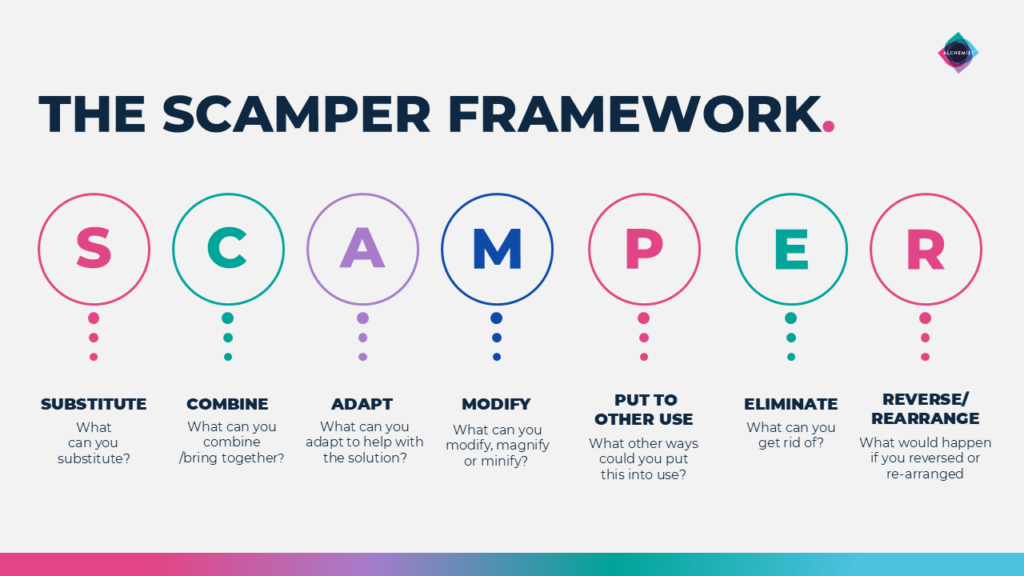
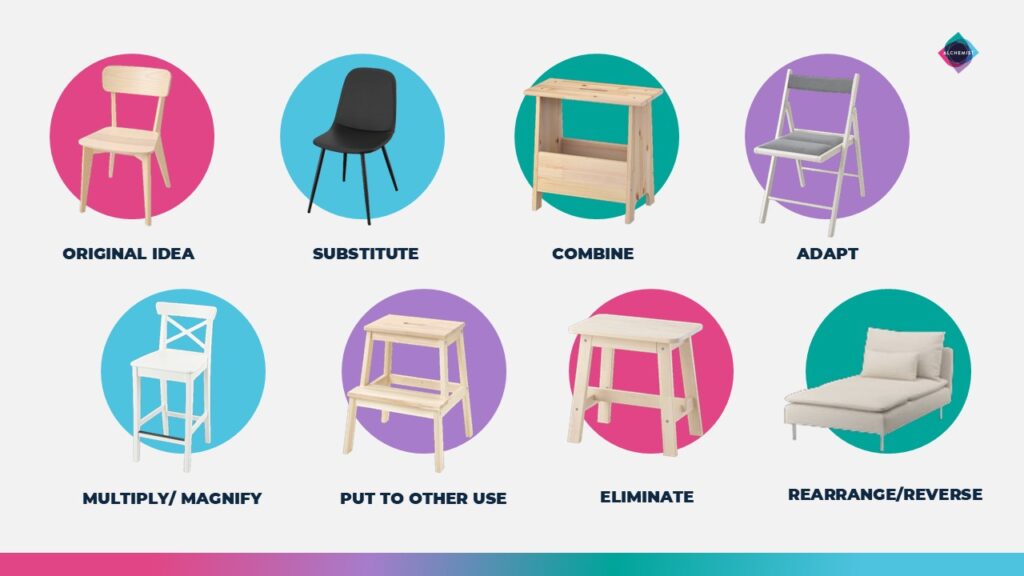
For example, if you use SCAMPER on an everyday object, like a chair, it might look like this:
-
- Substitute: Could the wooden legs be substituted with metal?
-
- Combine: Storage and a chair could be combined to add storage under the seat.
-
- Adapt: For smaller spaces, the chair could be foldable so it’s easier to store.
-
- Modify: Magnify the length of the legs to be used at a breakfast bar.
-
- Put to Other Use: With minimal changes, it becomes a step stool.
-
- Eliminate: Take off the back and it becomes a stool.
-
- Rearrange: Changing the proportions of the seat/back can make a chair you can sleep on.
At Alchemist, we use SCAMPER as a practical tool for teams to challenge assumptions and surface possibilities they might otherwise overlook. It’s one example of how structure, far from constraining creativity, can be what makes it accessible to everyone.
Dig even deeper into building innovation into your team and how to bring SCAMPER into everyday practices with your team in our on-demand webinar, Leaders Are Killing Innovation: Here’s How to Build It Into Your Team.
The Conditions Are the Strategy
It’s a tough time to be a leader. The expectations are contradictory, the resources are finite, and the pressure to deliver innovation alongside everything else can feel like an ask too many.
The leaders who navigate this well don’t have all the answers, but they build the conditions for their teams to find them.
As outlined in Deloitte’s research, competitive advantage is increasingly driven not by technology, but by the human edge – the adaptivity, creativity, and judgement that no tool can replicate. These behaviours don’t emerge from a workshop or a strategy deck, but from cultures where curiosity is valued, where psychological safety makes it possible to take risks, and where everyone gets to contribute.
Democratising innovation starts with leaders who consistently model the behaviours that make innovation possible at every level.
RELATED CONTENT
 See the SCAMPER framework in action and learn how to identify different types of curiosity.

Your leaders need to be able to have hard conversations. This playbook explores key moments and how to lead critical conversations.